
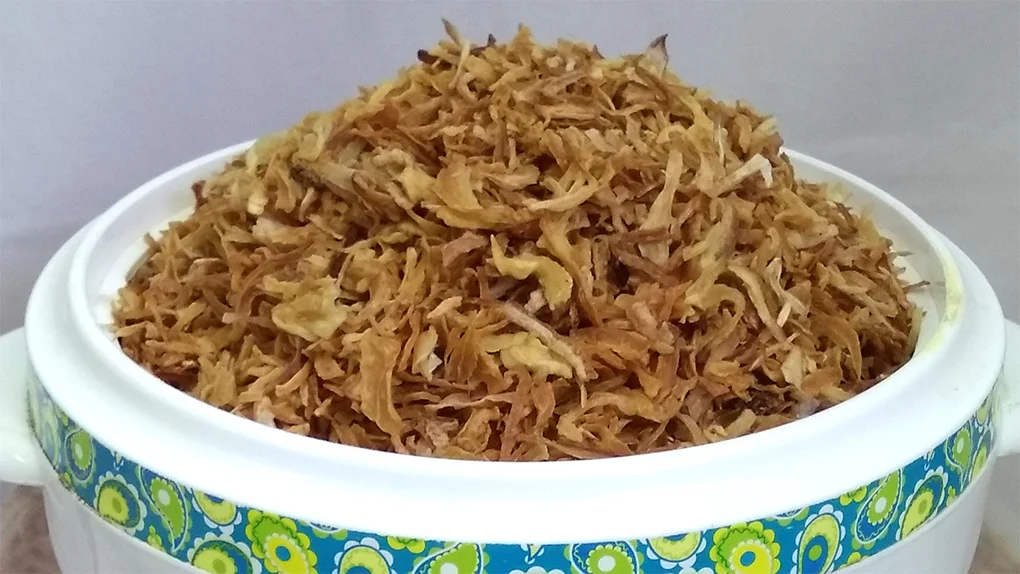
A cornerstone of Mughlai, Bohra, Hyderabadi, and royal Indian kitchens, Bilista (also spelled Birista) is the golden, shatteringly crisp fried onion garnish that gives biryanis, kormas, haleem, and khichda their unmistakable caramelized depth. Derived from the Persian word 'biryan' meaning fried or roasted, mastering bilista is considered an essential rite of passage in traditional South Asian cookery, transforming humble red onions into sweet, umami-rich ribbons without a trace of bitterness.
Achieving restaurant-grade crispness relies on uniform slicing, air-drying excess moisture before frying, and pulling the onions out of the oil a shade lighter than your target color. Because natural sugars in onions continue to caramelize rapidly from residual heat after leaving the kadhai, timing that golden lift ensures every batch cools into crisp, aromatic perfection.
Ingredients List
| Sr. | Weight | Units | Name |
|---|---|---|---|
| • | 500 | gms | Onions, preferably red, thinly sliced |
| Oil for deep frying | |||
Method / Instructions
- Peel the onions and slice them thinly and evenly. Spread the sliced onions over a clean cloth or paper towel and leave them for 10–15 minutes to remove excess surface moisture and encourage even frying.
- Heat sufficient oil for deep frying in a deep kadhai or heavy-bottomed pan over medium heat until hot enough to fry steadily.
- Add a small handful of sliced onions to the hot oil without overcrowding. Fry in batches, stirring frequently with a fork to separate them until light golden brown. Remove before they turn dark brown as residual heat will cook them further.
- As soon as the onions reach a light golden colour, remove with a slotted spoon and transfer immediately to a paper towel-lined tray, spreading them out in a single layer.
- Allow the bilista to cool completely at room temperature so they become noticeably crisp.
- Once completely cool, transfer the bilista to an airtight glass jar or container lined with kitchen paper. Store in a cool, dry place. Jamjo ane Jamarjo!
Nutrition Facts (Per Per 100 gms)
| Nutrient (Basic) | Amount (Approx.) |
|---|---|
| 🔥 Calories | 398 kcal |
| 💪 Protein | 3.6 g |
| 🌾 Carbohydrates | 34.2 g |
| 🥑 Total Fat | 27.4 g |
| 🧈 Saturated Fat | 3.1 g |
| 🌱 Dietary Fiber | 4.8 g |
| 🍬 Sugars | 16.5 g |
| 🧂 Sodium | 18 mg |
*Disclaimer: The nutritional values provided here are estimates generated for reference only and may vary based on exact ingredient brands and preparation techniques. Please calculate your nutrition independently if following a strict diet.
Chef’s Note
- Always pull your bilista out of the oil when it reaches a warm honey-blond shade rather than deep brown—carryover heat continues cooking the delicate onion ribbons on the tray for a full minute, and waiting too long turns sweet caramelization into acrid bitterness.
- Do not discard the leftover frying oil; strain it into a clean bottle and use it as the flavorful base for biryanis, pulaos, and rich meat gravies.
Tips & Tricks
- all onions to the exact same thinness using a mandoline slicer or sharp chef's knife so thinner strands do not burn while thicker pieces remain soggy.
- Air-dry the sliced onions on a cotton cloth for 15 minutes before frying; removing surface moisture prevents oil splatter and cuts frying time significantly.
- Keep the flame steady at medium—high heat scorches the edges before the moisture evaporates, while low heat makes the onions absorb excess oil and turn limp.
- Layer a dry paper towel at the bottom of your airtight glass jar and freeze stored bilista for up to 3 months to keep it crisp on demand.
Community Comments Reviews